Free shipping 

Best price guarantee 

SimpleCrew exclusive savings 

0% financing options 

Tire replacement coverage 

24/7 roadside assistance 

Easy returns 

Compare

All-Season vs All-Weather Tires: Which is Right for You?

All-Season vs All-Weather tires
Last updated 3/20/2026 - Originally published 9/20/2023
Written by SimpleTire, Expertly reviewed by Brett Antosh

Choosing between all-season vs all-weather tires can be confusing because the names sound nearly identical. However, while they share some DNA, there is significant daylight between the two in terms of rubber compounds, tread patterns, and performance limits. Whether you need the long-lasting efficiency of all-season tires or the severe-snow capabilities of all-weather tires, understanding the all-weather vs all-season divide is essential for road safety.
The Core Difference: All-Weather vs All-Season Tires

All-season vs All-Weather tires

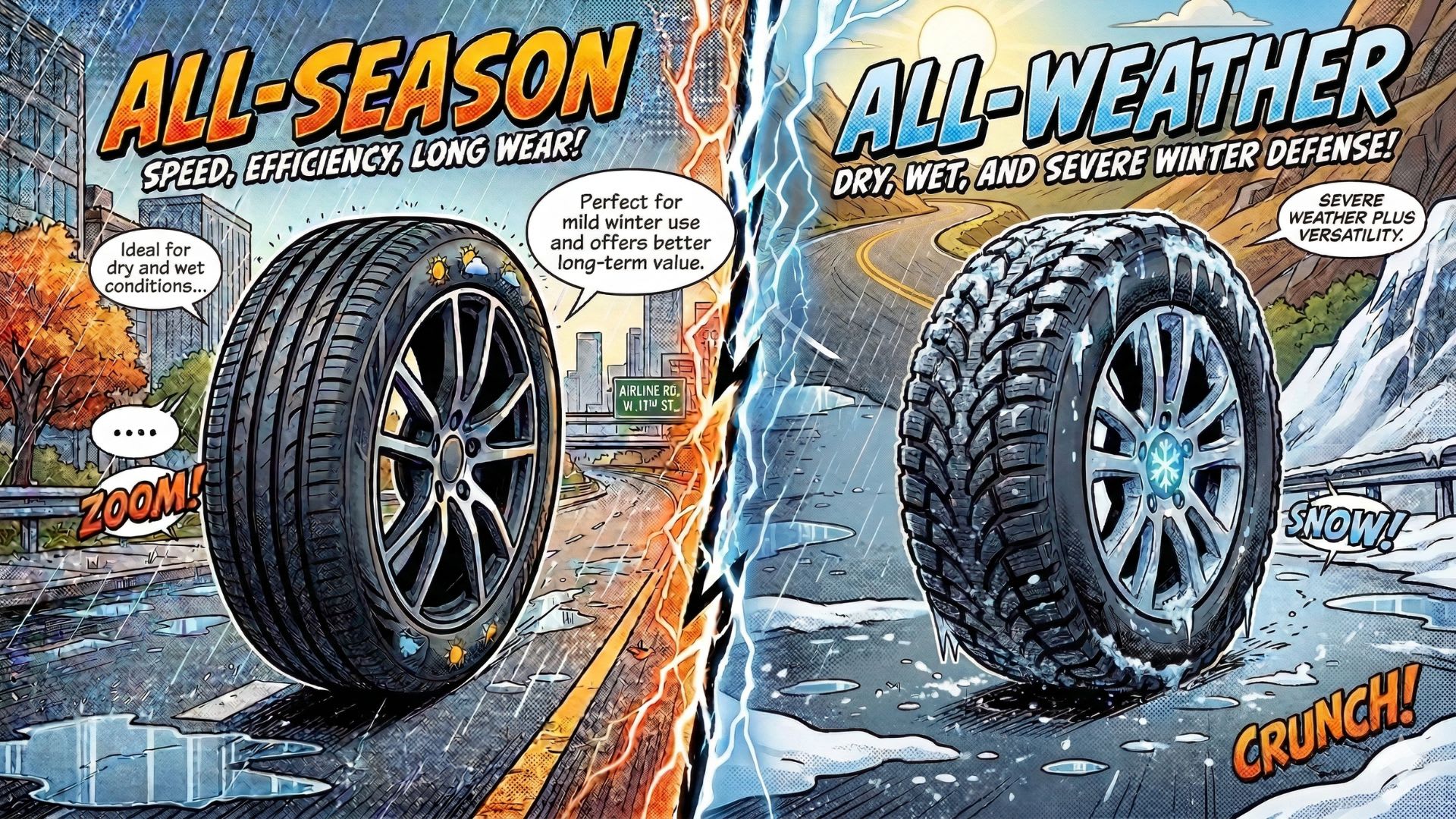
Before the 1970s, drivers had to swap between "highway tires" and clunky "snow tires." Today, the market is dominated by versatile options, but the all-weather vs all-season tires debate hinges on one factor: winter severity.

  • All-Season Tires: Designed for a "middle-of-the-road" compromise. They offer a quiet ride, long tread life, and reliable handling in dry and wet conditions.
  • All-Weather Tires: Think of these as "All-Season Plus." They maintain daily drivability but feature more aggressive tread blocks and specialized rubber to handle slush and snow.
  • Certification: Most all-weather tires carry the Three-Peak Mountain Snowflake (3PMSF) symbol, legally certifying them for severe snow service—a rating most all-season tires lack.

Fuel Economy: All-Season vs All-Weather

When comparing all-weather vs all-season efficiency, the specialized design of the tire plays a major role:

  • All-Season Advantage: These tires are optimized for low rolling resistance. Modern designs from brands like Continental focus on reducing weight to boost MPG.
  • All-Weather Trade-off: The deeper grooves and softer compounds required for snow can increase friction, sometimes costing an extra $100 in fuel annually.

Winner: All-season tires.

Performance in Rain: All-Weather vs All-Season

In wet conditions, the all-season, all-weather tires comparison is often a draw:

  • All-Season Design: Uses broad circumferential grooves to channel water away and prevent hydroplaning.
  • All-Weather Design: Often utilizes directional, chevron-shaped patterns to evacuate slush and heavy rain.
  • Shared Tech: Both types frequently use silica-rich compounds to maintain grip on slick pavement.

Winner: Tossup.

Performance in Snow: All-Season vs All-Weather Tires

Choosing between all-season and all-weather tires

This is where the distinction between all-weather vs all-season becomes crystal clear:

  • All-Weather Superiority: These tires use "sipes" (tiny slits) and a rubber compound that stays flexible in freezing temperatures. They are significantly better at stopping and turning in several inches of snow.
  • All-Season Limitations: Once temperatures drop below 45°F, the rubber on standard all-season tires can harden, leading to "slip-sliding" on icy patches.

Winner: All-weather tires.

Tread Life: All-Weather vs All-Season

  • All-Season Durability: Generally offers the longest tread life warranties (often 60k–80k miles) due to harder rubber compounds.
  • All-Weather Wear: Because the rubber is slightly softer to handle the cold, they may wear down faster in hot summer months.

Winner: All-season tires (by a narrow margin).

Common Customer Pain Points & Solutions

When deciding between all-season vs all-weather, many drivers face these common frustrations. Here is how to navigate them:

  • The "Storage Struggle": Many drivers lack the garage space to store a second set of tires. All-weather tires solve this by providing 36-peak snowflake safety on a single set of wheels.
  • The "First Snow" Panic: Every year, tire shops are overwhelmed during the first snowfall. Switching to all-weather vs all-season early means you’re already prepared before the rush hits.
  • Confusing Symbols: Don't rely on the "M+S" (Mud and Snow) rating alone—it is not a performance test. For true winter safety, look for the Three Peak Mountain Snowflake (3PMSF) symbol, which is standard on most all-weather tires at SimpleTire.
  • Budget vs. Safety: If you are on a tight budget, high-quality all-season tires are excellent for 90% of the year. However, if your commute involves steep hills or unplowed backroads, the slightly higher cost of an all-weather tire is a vital investment in safety.

Final Verdict: Which Should You Choose?

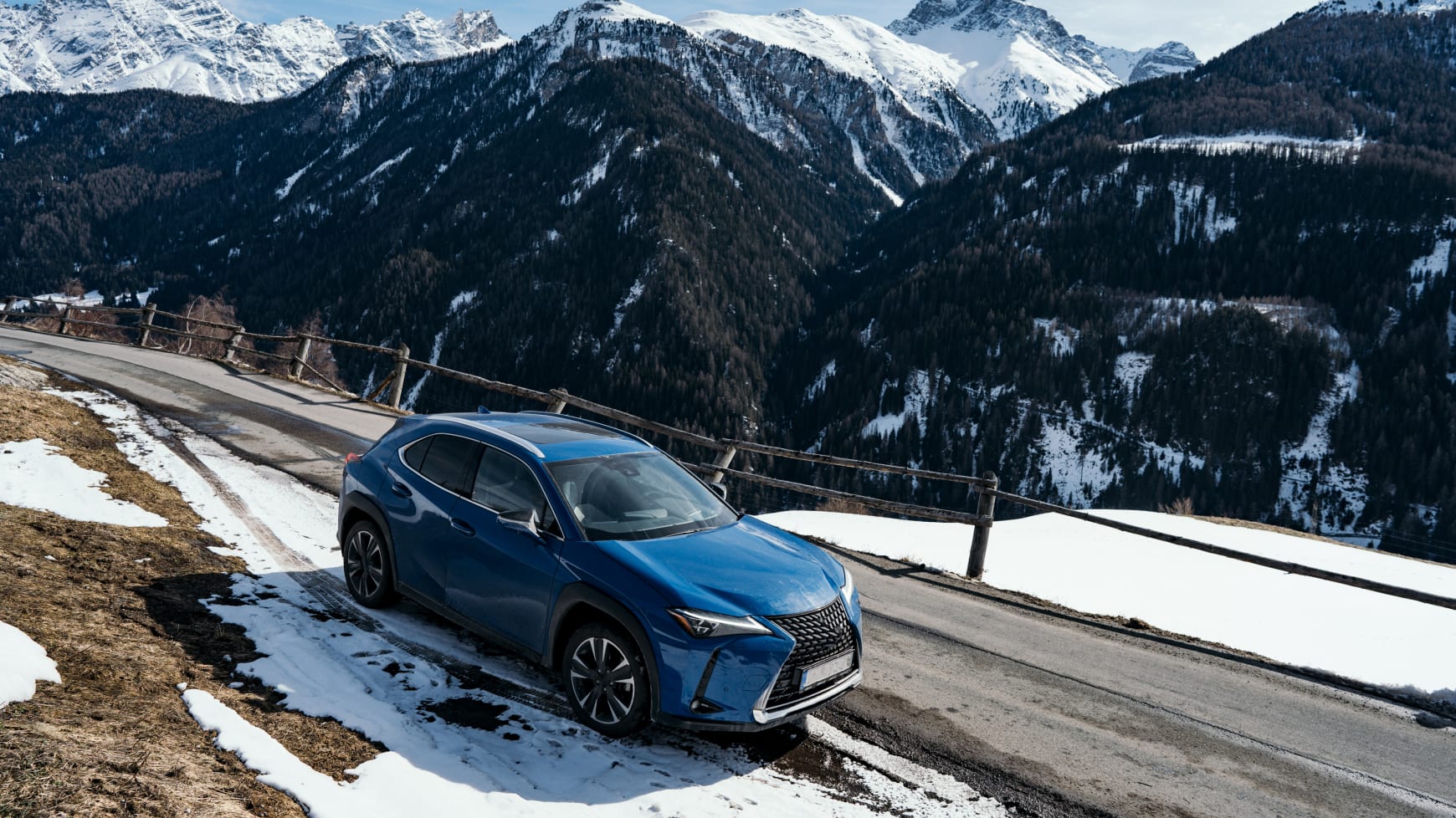
All-season tires on an SUV

When deciding between all-season vs all-weather, your local climate is the deciding factor.

Choose All-Season Tires if:

  • You live in a region with mild winters and little to no snow.
  • You prioritize maximum fuel efficiency and the longest possible tread life.
  • You want the most budget-friendly options for your sedan, minivan, or Crossover.

Choose All-Weather Tires if:

  • You face regular snow and slush but don't want the hassle of swapping to dedicated winter tires.
  • You frequently drive in temperatures that stay below freezing.
  • You want the peace of mind provided by the Three-Peak Mountain Snowflake rating.

No matter where you live, finding the right fit is easy. You can browse the full catalog of all-weather and all-season tires at SimpleTire to find the perfect match for your vehicle and budget.

Yes, you can drive on all-weather tires year-round. Unlike dedicated winter tires, which wear down rapidly on dry, hot pavement, all-weather tires are engineered with a rubber compound that remains stable in both summer heat and winter cold. This makes them the perfect "set it and forget it" solution for drivers who want the safety of a winter tire without the hassle of a bi-annual tire swap.

Most experts agree on the "45-degree rule".

All-season tires: Once the temperature drops below 45°F, the rubber begins to harden and lose its "grip" on the road. All-weather tires: These tires stay flexible well below freezing, ensuring you can still brake and turn safely in a cold snap.

Ready to find the perfect tires?

Search By